> For the complete documentation index, see [llms.txt](https://help.cerby.com/llms.txt). Markdown versions of documentation pages are available by appending `.md` to page URLs; this page is available as [Markdown](https://help.cerby.com/getting-started/concepts/credential-management/collections.md).
# Collections
This article describes the benefits of using collections to group and share accounts, secrets, business hubs, and subcollections.
With **Collections**, you can group your accounts, secrets, business hubs, and subcollections for easy organization in your dashboard. Additionally, they enable you to efficiently share items in bulk with other workspace members and teams for collaborative access.
If you have used other password managers, like LastPass or 1Password, collections are the equivalent of a folder or vault.
The following are the characteristics and actions you can perform with the Collections feature:
* Group accounts, secrets, business hubs, assets, and subcollections in a hierarchical structure.
* Share items in bulk with other members and teams assigning predefined roles (**Owner** and **Collaborator** roles on collections and subcollections) based on Cerby’s role-based access control (RBAC) system.
* Subcollections inherit access permissions from their top-level collection, simplifying permission management.
* Share multiple business hub integrations and assets with other members and teams, letting them claim access to their external app accounts when they are ready. As part of this process, you specify the app role to assign to the users and teams. For more information, read the article [Manage access to business hubs and assets with collections](https://help.cerby.com/setup-and-admin/business-hubs/managing-your-business-hubs/manage-access-to-business-hubs-and-assets-with-collections).
* Improve organization and searchability of items.
* Streamline collaboration and knowledge sharing.
* Enhance security and control over access to sensitive information.
{% hint style="info" %}
**NOTE:** Only item **Owners** can add their items to a collection, and share this collection with other workspace members. For more information about the roles on collections, read the article [Roles and permissions](/getting-started/concepts/user-management/roles-and-permissions.md).
{% endhint %}
***
## The Collections page
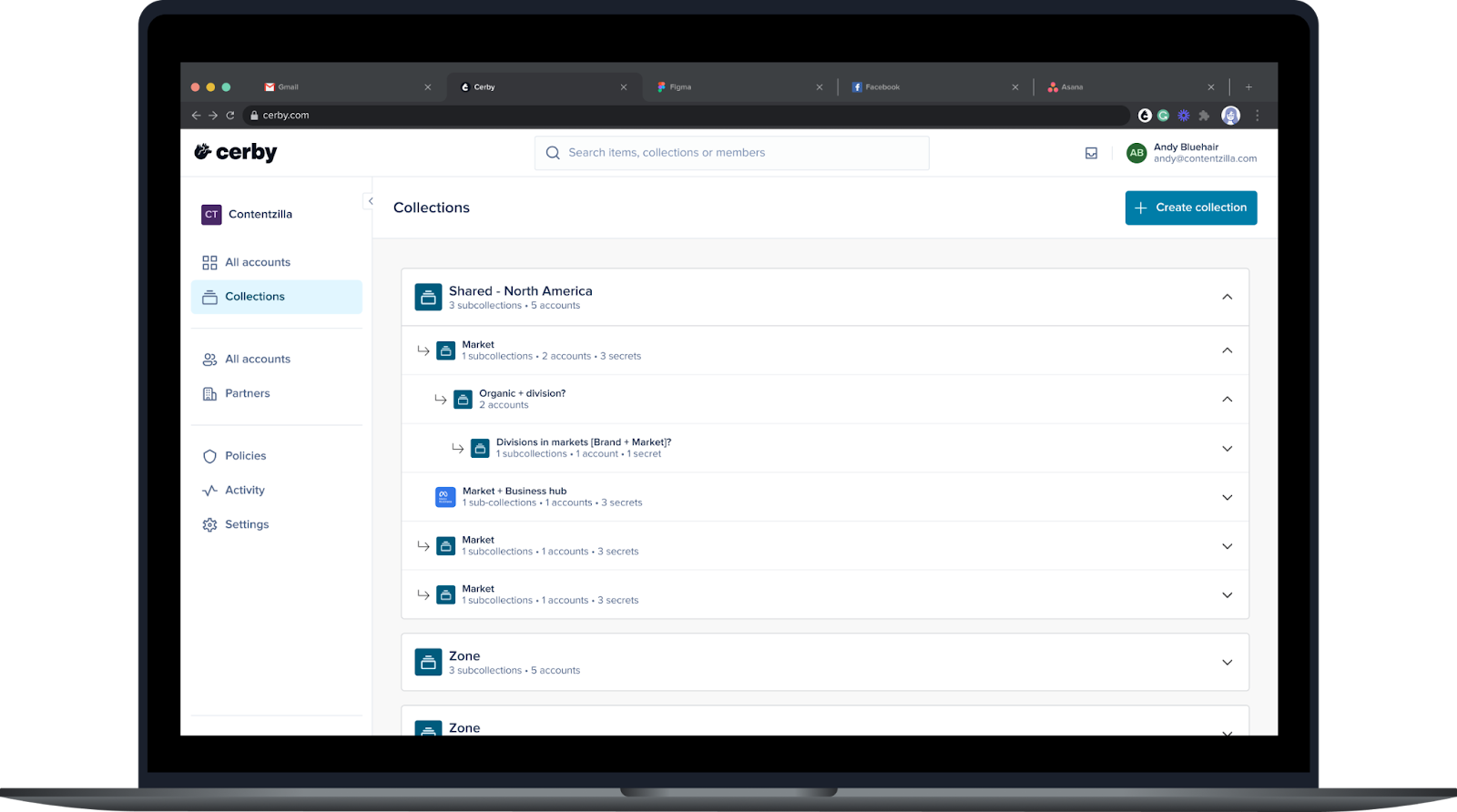
The **Collections** page displays all the root collections you have created or to which you have been granted shared access. This page provides a convenient location to access and manage your accounts, secrets, business hubs, assets, and subcollections in a hierarchical structure.
You can perform the following actions from the **Collections** page:
* View and interact with collection cards, accounts, secrets, business hubs, assets, and nested subcollections.
* Search for collections and subcollections by their name.
* Create a collection through a wizard by clicking the **Create collection** button.
* Access the collection settings page that enables you to see the members who have access to it and the items within it, share a collection, assign a subcollection, delete a collection, and others.
**Figure 1** shows the **Collections** page that you can access from the left menu of the Cerby web app dashboard.
Figure 1. Collections page in the Cerby web app dashboard
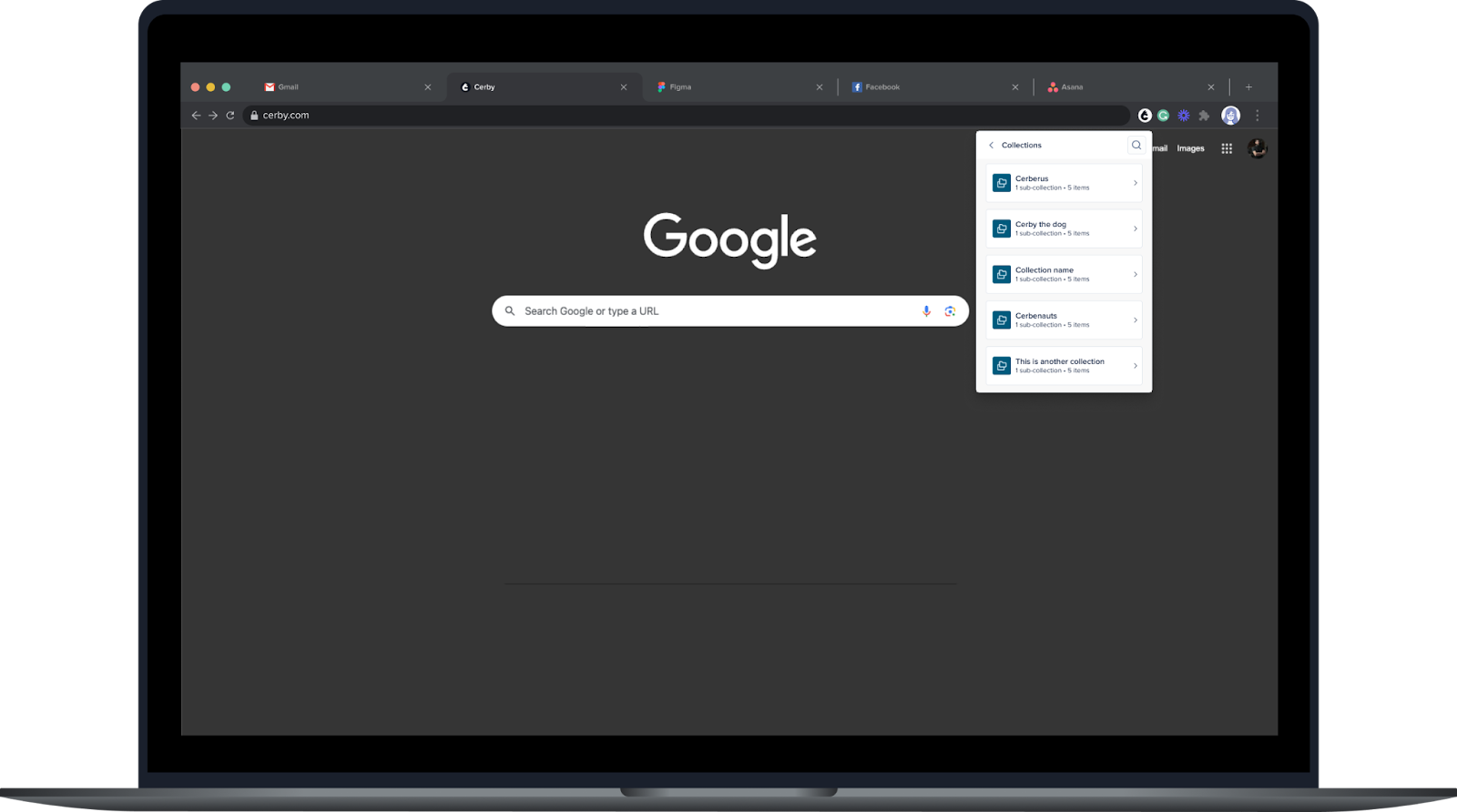
**Figure 2** shows the **Collections** page that you can access from the Cerby browser extension popup.
Figure 2. Collections page in the Cerby browser extension popup
---
# Agent Instructions
This documentation is published with GitBook. GitBook is the documentation platform designed so that both humans and AI agents can read, navigate, and reason over technical content effectively. Learn more at gitbook.com.
## Querying This Documentation
If you need additional information that is not directly available in this page, you can query the documentation by asking a question.
Perform an HTTP GET request on the following URL with the `ask` and `goal` query parameters:
```
GET https://help.cerby.com/getting-started/concepts/credential-management/collections.md?ask=&goal=
```
`ask` is the immediate question: it should be specific, self-contained, and written in natural language.
`goal` is what the user is ultimately trying to achieve, the reason they need the answer. Sharing it helps GitBook give you a better, more relevant answer. A goal is most helpful when it describes the outcome the user wants rather than restating the question. For example, with `ask=how do I create an API token`, a goal like `automate deployments from our CI pipeline` lets GitBook tailor the answer to that use case.
The response will contain a direct answer to the question and relevant excerpts and sources from the documentation.
Use this mechanism when the answer is not explicitly present in the current page, you need clarification or additional context, or you want to retrieve related documentation sections.